Colorado Springs vs. Denver: The $50K+ Price Gap Nobody Mentions
Colorado Springs vs. Denver: The $50K+ Price Gap Nobody Mentions
If you're relocating to Colorado — whether it's a remote job that finally lets you live anywhere, a retirement move, or a transfer with a new employer — chances are Denver is the first city that came up in your search. It's the name everyone knows. But if you haven't looked seriously at Colorado Springs yet, you're probably leaving money on the table, and possibly the lifestyle you actually want.
The Actual Price Gap
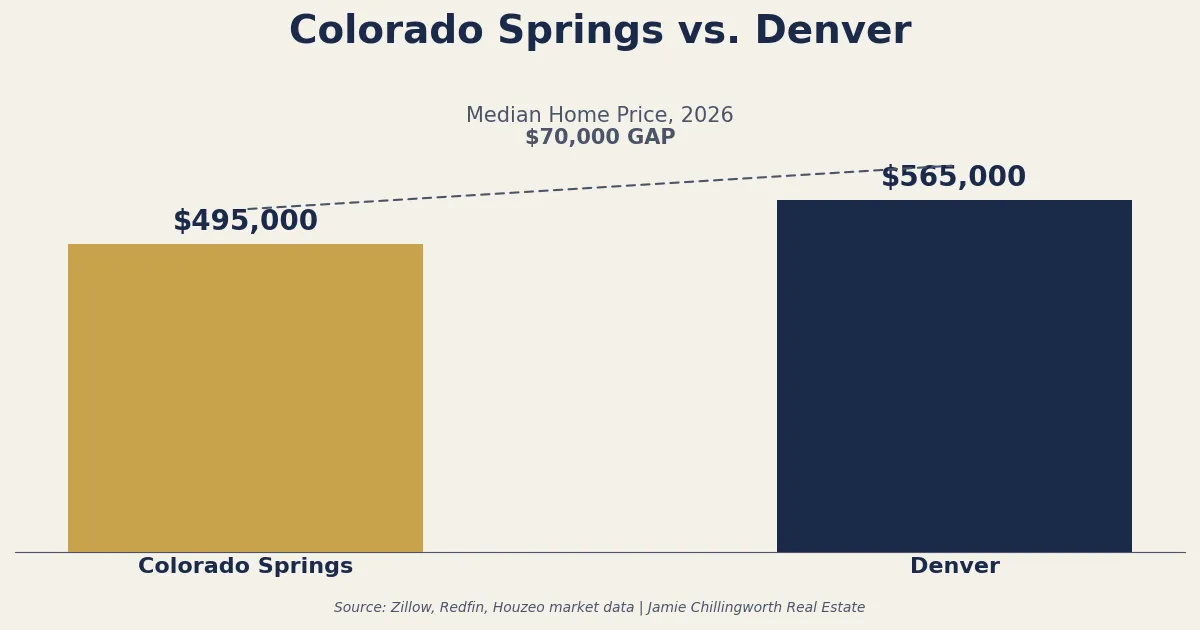
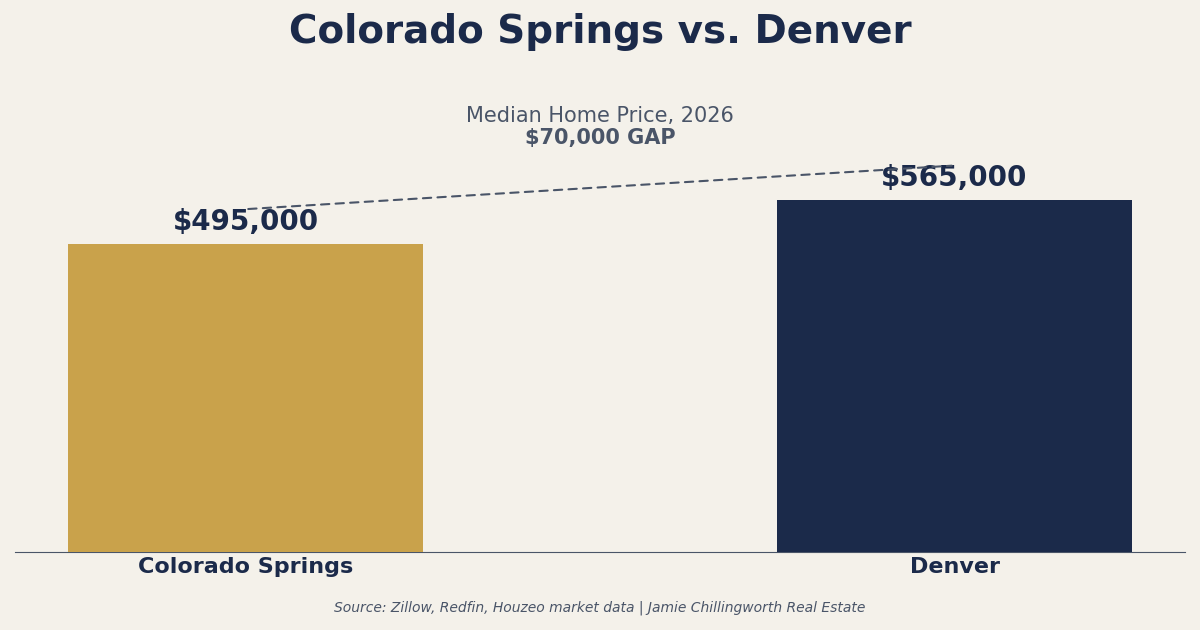
Colorado Springs' median home price sits in the neighborhood of $490,000–$500,000 as of mid-2026, compared to Denver's consistently higher median. Depending on the month and the data source, that gap runs anywhere from $50,000 to well over $100,000 for a comparable home. That's not a rounding error — on a typical 30-year mortgage at today's rates, a $50,000 difference in purchase price can mean $250–$300 less in your monthly payment, or the difference between a starter home and one with the extra bedroom, the finished basement, or the mountain view you didn't think you could afford.
And this isn't a temporary dip. Colorado Springs has trended below Denver in median sale price for years running, according to recent Zillow and Redfin data. This is a structural difference in the two markets, not a fluke of timing.
Why the Gap Exists — and Why It's Not a Downgrade
People sometimes assume a lower price tag means a lesser city. That's not what's happening here. Colorado Springs is Colorado's second-largest city, and it's been ranked among the most desirable places to live in the country — U.S. News & World Report has placed it in the top three nationally in recent years, and Forbes has ranked it near the top for overall desirability. It has the same access to the Front Range and the mountains that draws people to Denver, five military installations that anchor a stable local economy, and a downtown that's in the middle of a genuine boom — nearly doubling its residential population in the past year alone, with hundreds of new apartment units opening in the core.
What you're getting in Colorado Springs isn't "Denver, but cheaper and worse." You're getting a city that's smaller, easier to navigate, closer to some of the best hiking and outdoor access in the state, and growing fast enough that waiting a few years to buy in probably means paying more for it.
What This Means If You're Relocating Right Now
If you're comparing the two cities purely on lifestyle, it's worth knowing that Colorado Springs tends to feel less frantic and more connected to the outdoors day-to-day, while still offering a real downtown scene, without Denver's traffic or price pressure.
If you're comparing them financially, the math is straightforward: the same budget goes noticeably further in Colorado Springs, whether that means more house, less mortgage, or the ability to move now instead of waiting to save up for a Denver down payment.
And if you're not sure which neighborhoods make sense for your situation — commute, schools, walkability, proximity to base, or just wanting to be near the mountains — that's the part that's hard to research from out of state. Listing sites can tell you square footage. They can't tell you that one street floods every spring, or that a certain neighborhood has completely changed character in the last two years because of new development.
Next Step
If you're actively comparing Denver and Colorado Springs, or you've already decided on the Springs and just need boots on the ground, let's talk. A free 15-minute relocation call can save you weeks of scrolling listings that don't tell the whole story.
Book a free 15-minute relocation call — reach out and we'll map out neighborhoods, price ranges, and a realistic timeline before you ever have to fly in.


